

- HOME
- Water Quality Testing for Building & Residential Properties
Water Quality Testing for Multi-Occupant Facilities
Essential for Shared Water Systems
Apartment
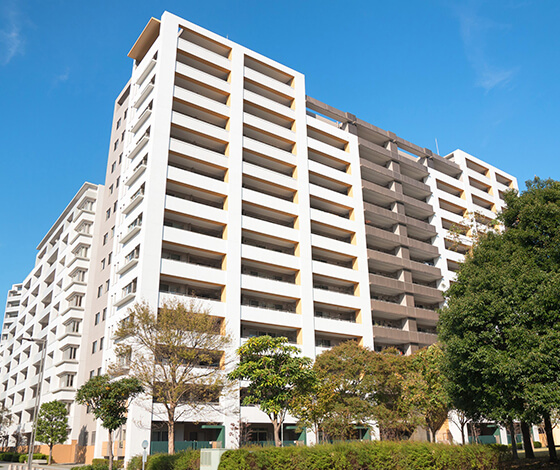
In buildings and condominiums used by many people, complaints about water quality can quickly escalate
into liability issues for the facility manager.
For example, rust and bacterial growth inside supply pipes can cause water discoloration. Algae in
storage tanks and excessive residual chlorine can result in chlorine-like and metallic odors. High
concentrations of iron, zinc, copper, and other metals can cause astringent or bitter tastes. These
problems cause significant concern among building occupants.
Conducting regular water quality testing before complaints arise is an effective preventive measure for
risk management.
Legal Requirements for Building Water Quality Testing
Depending on the scale of the building and the type of water supply, water quality testing may be
legally required. Even for buildings not subject to specific regulations, failure to conduct periodic
testing can lead to unexpected incidents. A single missed inspection can result in administrative
guidance and questions regarding managerial responsibility.
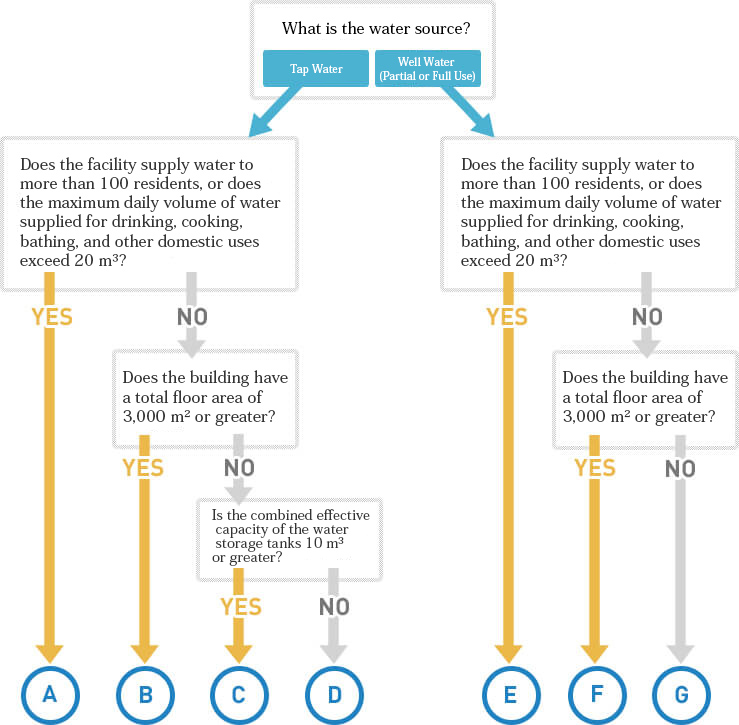
Please refer to the flowchart below to determine the appropriate testing for the building you occupy or
manage.
Drinking Water Testing
The required testing varies depending on the classification of the water supply. Please use the following reference table to identify the appropriate test items for your property.
※表は左右にスクロールして確認することができます。
| Category | Water Supply Classification (Related Legislation) | Test Items (Frequency) |
|---|---|---|
| A | Private Water Supply (Water Supply Act) |
|
| B | Designated Building (Building Sanitation Act) |
|
| C | Building Water Tank System (Water Supply Act) |
|
| D | Small-Scale Water Supply Facility (local ordinances) |
|
| E | Private Water Supply (Water Supply Act) |
|
| F | Designated Building (Building Sanitation Act) |
|
| G | Drinking Well Water Supply Facility (Drinking Well Hygiene Guidelines) |
|
* If the previous 16-item test results were compliant, the next test may be reduced to the 11-item test.
Non-Potable Water & Other Testing
Non-Potable (Miscellaneous-Use) Water Testing
If the facility you manage is classified as a “Designated Building,” the Act on Maintenance of Sanitation in Buildings (Building Sanitation Act) applies, and proper maintenance of non-potable water quality is legally required.
Wastewater Analysis
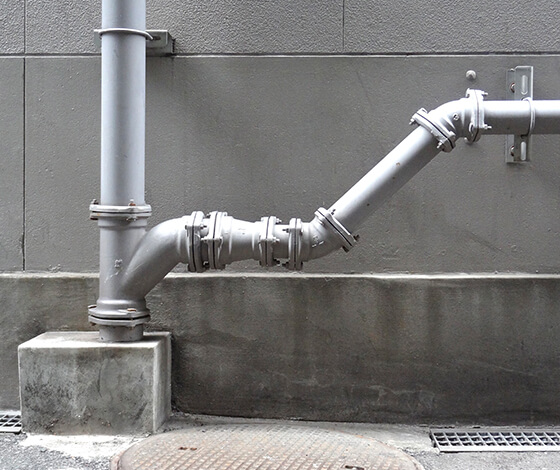
When a building houses restaurant kitchens, hospitals, or similar facilities, there is a higher likelihood that wastewater will contain substances and bacteria different from those found in ordinary household discharge. As a result, facilities classified under approximately 70 categories of designated facilities or operations are required to conduct wastewater analysis in accordance with applicable discharge standards.
Bacteriological Testing
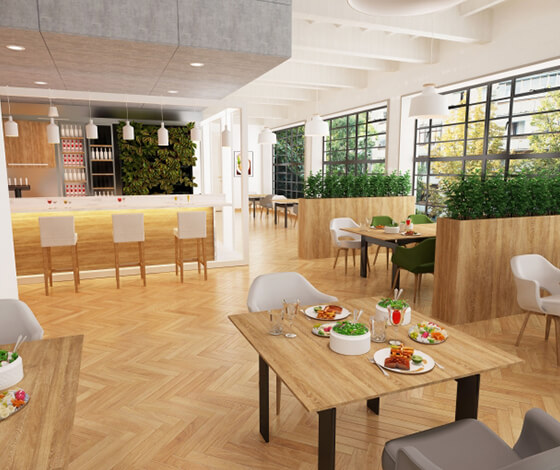
Bacteriological testing is highly effective for evaluating cleanliness in areas with high foot traffic (civic halls, gymnasiums, etc.) and for managing hygiene in food preparation areas such as restaurant kitchens within buildings. For details, please refer to our Bacteriological Testing page.
Designated Buildings (Specified Buildings under the Building Sanitation Act)
Buildings such as department stores, assembly halls, schools, and libraries are classified as
“Designated Buildings” and are subject to the Act on Maintenance of Sanitation in Buildings
(Building Sanitation Act). Designated Buildings are legally required to implement various measures to
maintain sanitary conditions, and water quality testing is also required.
To provide water that can be used and consumed with confidence, it is important to conduct thorough
water quality testing beyond just the legally mandated inspections.
The following building types are classified as Designated Buildings:
Category 1 — Buildings with a designated-use floor area of 3,000 m² or more:
- ①Includes theaters, department stores, assembly halls, libraries, museums, art galleries, amusement facilities
- ②retail stores, offices
- ③hotels/inns
- ④training facilities (schools not defined under Article 1 of the School Education Act)
Category 2 — Schools defined under Article 1 of the School Education
Act with a total floor area of 8,000 m² or more:
Includes elementary schools, junior high schools, senior high schools, secondary education schools,
universities, colleges of technology, special needs schools, kindergartens, and similar institutions.
Designated Buildings are required to conduct periodic water quality testing for drinking water (tap water and groundwater), hot water (centralized recirculating systems), and non-potable water. The 12-item disinfection byproducts test must be conducted during the designated period of June through September.
| Drinking Water & Hot Water — Testing Schedule | |||||||
|---|---|---|---|---|---|---|---|
| Testing Period | Every 6 months | Designated period
(Jun–Sep) |
Every 3 years | Before water supply commencement | Every 7 days | Every 2 months | |
| Drinking Water & Hot Water | Tap Water | 16-item test ※ | Disinfection byproducts 12-item test | ||||
| Groundwater | 16-item test ※ | Disinfection byproducts 12-item test | Organic chemicals 7-item test | 52-item test | |||
| Non-Potable Water | Toilet Flushing Water | 4-item test | 1-item test | ||||
| Other Non-Potable Water | 4-item test | 2-item test | |||||
| Drinking Water & Hot Water — Testing Schedule | ||
|---|---|---|
| Testing Period | Drinking Water & Hot Water | |
| Tap Water | Groundwater | |
| Every 6 months | 16-item test * | 16-item test * |
| Designated period
(Jun–Sep) |
Disinfection byproducts 12-item test | Disinfection byproducts 12-item test |
| Every 3 years | Organic chemicals 7-item test | |
| Before water supply commencement | 52-item test | |
| Every 7 days | ||
| Every 2 months | ||
| Testing Period | Non-Potable Water | |
| Toilet Flushing Water | Other Non-Potable Water | |
| Every 6 months | ||
| Designated period
(Jun–Sep) |
||
| Every 3 years | ||
| Before water supply commencement | ||
| Every 7 days | 4-item test | 4-item test |
| Every 2 months | 1-item test | 2-item test |
* Note: If the 16-item test results are compliant, the next test (6 months later) may be reduced to the 11-item test. However, the 16-item test must be conducted again 6 months after the 11-item test is performed.